Must-Have Tools For Professional Granite Cutting Jobs
Granite cutting is a precise and intricate task that requires specialized tools to ensure both safety and quality. One of the most important tools for cutting granite is a diamond blade. Diamond blades are specifically designed to handle the hardness of granite, making them ideal for the job. These blades come in different types, including dry-cut and wet-cut varieties, with wet-cutting blades being preferred due to their ability to reduce heat buildup and dust, prolonging the life of the blade and improving the cutting process. To use the diamond blade effectively, professionals typically employ a cutting saw, such as a circular saw or a bridge saw. Circular saws are portable and versatile, allowing workers to make straight cuts on smaller granite slabs. A bridge saw, on the other hand, is often used for larger projects, offering greater precision and the ability to cut thicker granite slabs. For even more specialized tasks, a tile cutter might also be used when cutting smaller granite pieces for intricate designs or mosaics.
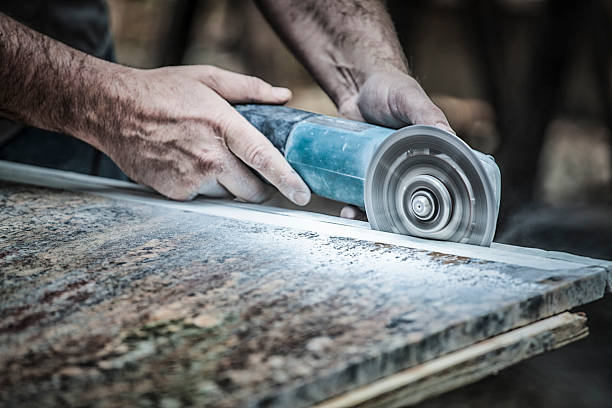
In addition to cutting saws, professionals often rely on edge polishers and grinders to smooth the edges of granite after it has been cut. Grinders with diamond cup wheels are commonly used to remove rough edges, giving the granite a polished and finished look. These grinders can also be used to shape and smooth the surface of the granite, preparing it for installation or further detailing. For larger projects, such as countertops or large slabs, a granite CNC machine can be a game-changer. CNC machines are computer-controlled and allow for highly accurate cuts and shapes. These machines are particularly useful for creating custom designs and ensuring uniformity across multiple pieces of granite. The precision and efficiency of CNC machines reduce the amount of manual labor required, speeding up the process and minimizing the potential for errors.
Safety equipment is equally important when cutting granite, as the process generates a significant amount of dust and debris. Professionals should always wear a high-quality respirator or dust mask to protect their lungs from inhaling harmful particles. Eye protection is also critical to prevent debris from causing injury, and hearing protection is essential when working with loud machinery like saws and grinders. Additionally, sturdy gloves should be worn to protect hands from sharp edges and the vibration of power tools. Lastly, clamps and supports are essential for holding granite securely in place during cutting. Granite is heavy and can be challenging to manage, so using adjustable clamps or suction cups can help keep the material steady, preventing accidents and ensuring precise cuts. A well-organized workspace with ample lighting and clear surfaces also contributes to efficiency and safety during granite cutting jobs. Overall, a combination of high-quality cutting tools, safety equipment, and support systems is crucial for professionals in the granite cutting industry.